On this page
A useful H&C support letter explains what the writer personally knows about the applicant, the relationship and the circumstances that matter. Specific observations are more helpful than a page of praise or a copied appeal for sympathy. The letter should be truthful, dated and consistent with the rest of the application.
Support letters are one part of the evidence. They do not replace the official application checklist, identity records or a clear explanation of the humanitarian request. Begin with the in-Canada H&C guide to understand how the evidence fits into the process.
Discuss your supporting evidence with our team.
Key takeaways
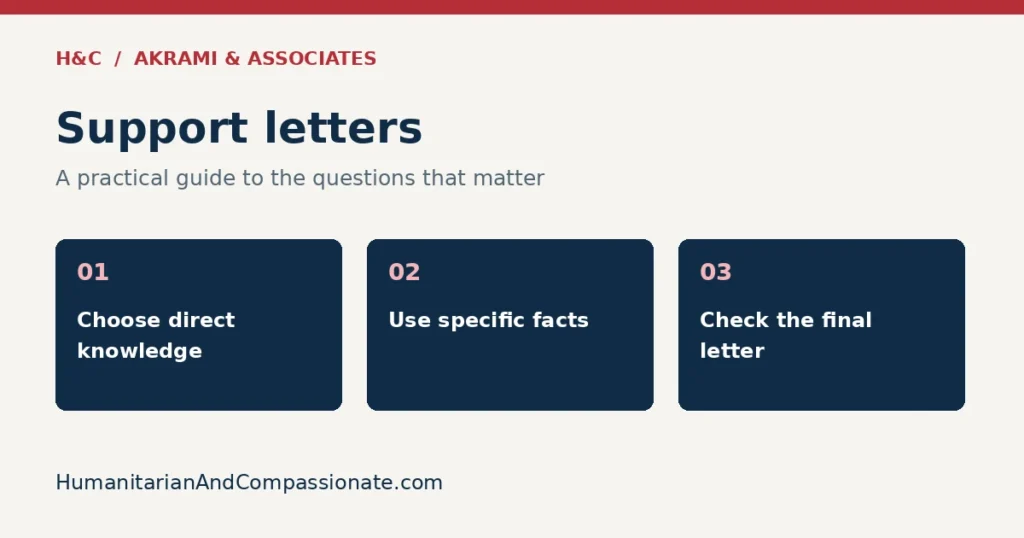
- Choose writers who can explain relevant facts from direct knowledge.
- Describe the relationship, its duration and the frequency of contact.
- Use concrete examples rather than broad claims about character.
- Do not script identical letters or invent observations.
- Explain the significance of the letters in the overall submission.
Decide what the letter is meant to show
Before asking someone to write, identify the point they can help establish. A neighbour may know about daily assistance. An employer may know about work history and responsibilities. A teacher may know about a child’s school circumstances. Each person has a different perspective.
A useful request explains the purpose without dictating the conclusion. Ask the writer to describe facts they know and the limits of their knowledge. They should not feel pressured to claim expertise or certainty they do not have.
Avoid collecting letters solely because the writer has an impressive title. A detailed account from someone with direct knowledge may be more informative than a brief endorsement from someone who barely knows the applicant.
Explain the relationship at the beginning
The reader should quickly understand who is writing, how they know the applicant and how long they have known them. Include the nature and frequency of contact. A relationship lasting several years but involving occasional meetings differs from daily caregiving or close work contact.
Dates and examples help establish context. If the writer’s knowledge is limited to a particular period, say so. Do not imply that they observed events before the relationship began.
The writer should provide appropriate identifying and contact information so the account can be understood and, where necessary, verified. Discuss any privacy or safety concerns with the professional preparing the application rather than supplying unnecessary identification documents automatically.
Use observations instead of generic praise
A statement such as “this is a good person who deserves to stay” expresses support but provides little evidence. A more informative letter explains what the writer has seen: responsibilities carried out, regular assistance, participation in an organisation or the effect of a relationship.
For example, an employer can describe the role, dates and responsibilities within their knowledge. A community organiser can explain activities and the applicant’s contribution. A family member can describe care arrangements and what they personally rely on.
Specificity does not require dramatic language. Ordinary details can help the reader understand a real relationship. The aim is accuracy, not exaggeration. Avoid claiming that an outcome is certain when the writer can only describe a concern or expectation.
Distinguish facts, opinions and information from others
A letter can contain all three, but it should make the distinction clear. “I saw” differs from “the applicant told me,” and both differ from a professional opinion based on an assessment. Blurring those categories can make the evidence difficult to evaluate.
If a writer describes something learned from the applicant, they should say so. They should not present it as a direct observation. Where records exist, consider whether the original record is a better source for the fact.
Professional writers should remain within their expertise. A teacher should not diagnose a medical condition; a health professional should not promise immigration approval. A focused explanation of the writer’s actual knowledge is more useful than an opinion about every part of the case.
A practical structure for a support letter
| Section | What to include |
|---|---|
| Introduction | Writer’s identity, role and purpose |
| Relationship | How the writer knows the applicant and for how long |
| Direct observations | Specific events, responsibilities or circumstances |
| Relevant effect | How the issue affects the writer or another person, where known |
| Limits and supporting context | What is uncertain or outside the writer’s knowledge |
| Closing | Date, signature and suitable contact details |
This is an organising outline, not a government form or a mandatory formula. The final letter should sound like the writer and fit the facts. Do not fill it with statements merely because they appear in a template.
Letters about children and caregiving
Where a child is directly affected, the writer should explain the child’s actual circumstances and the applicant’s role. Describe relevant routines, responsibilities and observations. Avoid assuming that the child’s citizenship alone answers the humanitarian question.
A teacher or caregiver can explain what they know about the child’s needs or relationships. They should distinguish observations from predictions and avoid repeating an adult’s claims as established fact.
For adult caregiving, identify the tasks, frequency and dependency involved. If alternatives are relevant, explain what the writer knows about them. A statement that “nobody else can help” should not be used casually when the writer has not assessed the available arrangements.
Employment and community letters
An employment letter may support part of the establishment account, but it should be consistent with the actual work history and immigration documents. Do not ask an employer to hide dates or change the nature of the work to avoid a difficult issue.
Community letters can describe participation, responsibilities and relationships. A detailed explanation of a regular contribution is generally more informative than a certificate or one-line endorsement with no context.
The humanitarian application should explain why this evidence matters. A collection of letters without an accompanying account can leave the reader to guess how the material supports the requested exemption. The eligibility guide explains the broader need to connect circumstances to relief.
Hypothetical example: improving clarity without exaggeration
Consider a neighbour who initially writes, “She helps everyone and Canada needs her.” The neighbour could instead describe that the applicant has assisted with a particular weekly task for a stated period and explain the relationship from direct knowledge.
The improved version does not need to predict approval or claim that no one could ever replace the applicant. It helps by making the facts understandable. This hypothetical illustrates writing quality; it is not a real client account or a sample to copy into an application.
Translation, signatures and attachments
Follow the current application instructions for documents not in English or French. Keep the required translation materials with the letter and check that names, dates and important details are accurately represented.
A dated signature helps identify the final version. If an affidavit, statutory declaration or other formal document is proposed, obtain advice about whether that format is appropriate and how it must be completed. Not every ordinary support letter becomes stronger merely by being labelled an affidavit.
Attachments should have a clear purpose. Do not collect unnecessary sensitive identification or unrelated records from writers. Ask how to handle privacy concerns and provide material through an appropriate channel rather than a public website comment or general inquiry form.
Check consistency without rewriting the writer’s experience
Review names, dates and factual statements for obvious errors. If something conflicts with another record, ask for clarification. Do not silently edit a signed letter or change a writer’s words to fit the application.
The writer should approve the final version they sign. If a correction is needed, keep the process clear and obtain an updated letter where appropriate. Preserve earlier versions when they are relevant to understanding a discrepancy.
Different writers may describe the same event from different perspectives. That is not necessarily a problem. The goal is truthful evidence, not a set of letters that all use the same language and appear to come from one source.
Update letters when circumstances change
A letter describes the writer’s knowledge at a point in time. If a significant event occurs while the application is pending, an updated account may be useful. Explain what is new and avoid sending the same letter repeatedly without a reason.
Keep a record of what was submitted and when. The update should be linked to the correct application and should not be assumed to extend another deadline or guarantee that IRCC will wait indefinitely before deciding.
Book a consultation about your support letters if you need help identifying relevant writers, addressing gaps or placing the evidence in the wider submission.
Frequently asked questions
How many support letters should I obtain?
There is no universal number that guarantees a stronger case. Choose letters that add relevant information. Several repetitive letters may contribute less than a smaller number of specific, reliable accounts.
Must every writer be a Canadian citizen?
Do not assume that citizenship is the measure of useful evidence. The writer’s relationship, direct knowledge and the relevance of their account matter. Follow any specific application requirements and obtain advice where needed.
Can a relative write a support letter?
Yes, a relative may have important direct knowledge. The relationship should be clear, and the letter should explain facts rather than rely only on affection or a request for sympathy.
Can I draft the letter for someone else?
You may discuss the information needed, but the writer must understand and approve the account as truthful. Do not attribute observations or opinions to them that they do not hold.
Does notarisation guarantee that IRCC will accept the contents?
No. Formal execution does not prove every statement or guarantee a favourable decision. The document’s relevance, accuracy and evidentiary value still matter.
Should writers promise to support me financially?
They should only describe genuine arrangements they understand and can accurately explain. Obtain advice about the relevance and implications. Do not invent commitments to make the application appear stronger.
Should I use a sample letter found online?
An outline can help with organisation, but copied facts or identical phrasing are unsuitable. The letter should reflect the writer’s actual knowledge and your circumstances.
Can I add letters after the application is submitted?
Relevant new evidence can be provided through the appropriate IRCC process while the file is pending. Explain what it adds and retain submission confirmation rather than repeatedly sending duplicate material.
Make each letter earn its place
Ask what the letter proves, how the writer knows it and why it matters. Book an H&C consultation or call 416-477-2545 for guidance on organising the complete evidence package.
Official sources
General information only. Individual circumstances require professional assessment. Sources checked November 26, 2026.