On this page
Approval in principle is a positive first-stage decision on an H&C application; it is not final permanent resident status. A positive eligibility decision may provide a basis to apply for a work or study permit under the relevant rules. Simply filing an H&C application, receiving an acknowledgement or waiting for a decision does not itself authorise employment.
This guide explains the documents and questions to review when planning work during H&C processing. For the complete permanent residence process, see H&C applications in Canada.
Discuss your H&C stage and permit questions.
Key takeaways
- Identify the exact decision you received rather than relying on a nickname for it.
- Approval in principle and final permanent residence are different stages.
- Permit eligibility and permission to start working are separate questions.
- Existing permit conditions and expiry dates still require attention.
- Do not confuse H&C with a bridging work permit program for another PR category.
Understand the two-stage process
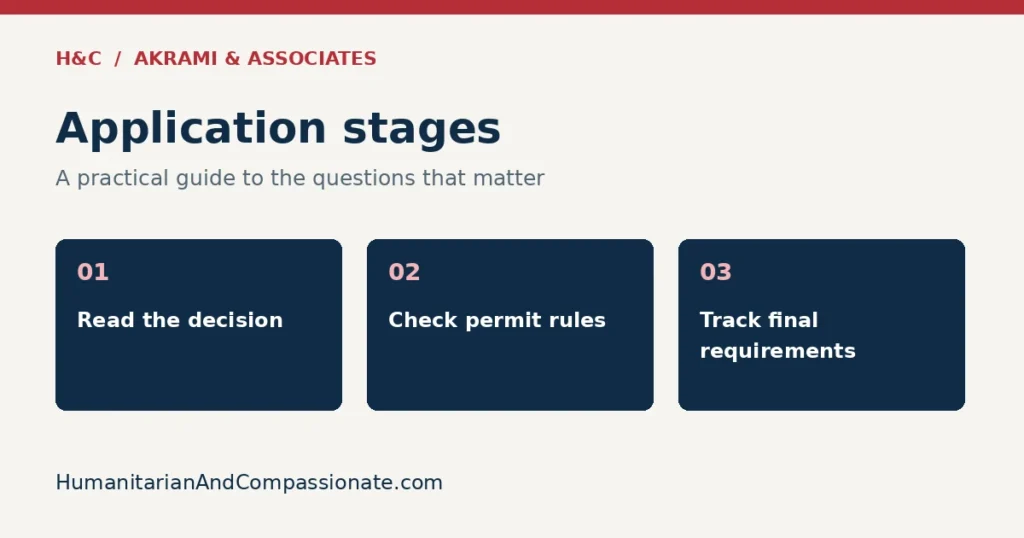
IRCC’s processing instructions describe an initial H&C assessment of the requested exemptions and a final decision on permanent residence. The first stage considers whether the humanitarian relief is justified. The later stage addresses remaining requirements.
The exact content of a decision matters. Read the letter for what has been accepted, what remains outstanding and any next steps. Do not assume that every issue raised in the application has been waived because the first stage was positive.
Final requirements can include identity, admissibility, medical or family-related matters, depending on the case. A positive first-stage decision therefore does not make later correspondence optional. Keep the file current and respond to requests through the appropriate channel.
Distinguish common communications
| Communication | What it generally shows | What not to assume |
|---|---|---|
| Submission confirmation | An application was submitted | That eligibility was approved |
| Acknowledgement or file number | The file has entered a processing step | That a work permit has been granted |
| Request for information | IRCC needs specified material | That the final outcome is decided |
| Positive eligibility decision | A first-stage assessment was favourable | That permanent residence is complete |
| Work permit approval | A permit decision has been made | That there are no conditions or expiry date |
| Final PR confirmation | Permanent residence has been confirmed through the applicable process | That earlier documents can be read in isolation |
Different cases may receive different communications. This table is a reading aid, not a prediction of the order or timing of every letter.
When a work permit may become available
IRCC has stated that in-Canada H&C applicants may apply for a work or study permit after a positive eligibility decision. The person must still satisfy the relevant permit rules and follow the current application instructions. The positive H&C decision is not itself a work permit.
Some people may have another legal basis for work authorisation before that stage. Others may fall under a specific measure with different requirements. Those possibilities should be assessed on their own terms rather than described as a general right for all H&C applicants.
Bring the actual approval letter, current immigration documents and any existing permit applications to your consultation. This allows the adviser to identify the relevant route and the evidence needed, rather than working from a summary such as “I passed stage one.”
If you already hold a valid work permit
Review the permit’s expiry date and conditions. It may restrict the employer, occupation or location, or contain other conditions. A pending H&C application does not automatically remove them.
If the permit will expire, seek advice before the expiry date about whether a qualifying extension or other application is available. Do not wait for an uncertain H&C decision on the assumption that approval will arrive in time.
Keep copies of any application made before expiry and its submission confirmation. The application type and timing can matter to maintained status and work authorisation. A general permanent residence submission is not interchangeable with a qualifying work permit extension.
If the permit has already expired
First establish whether you have a separate basis for maintained status or work authorisation. The answer depends on the actual applications and circumstances. Do not conclude that you may work solely because an application remains pending.
Restoration may be relevant in specified cases, but it is a different process and ordinarily does not permit continued work while awaiting a decision. Any exception or special public policy must be verified under current instructions.
The out-of-status eligibility background and application restrictions pages help explain why several legal questions may need to be assessed together. Explain all periods of work accurately when seeking advice.
Avoid confusion about bridging open work permits
People often hear that a permanent residence applicant can obtain a bridging open work permit and assume that the same rule applies to every PR application. Eligibility depends on the specified program and current requirements. Do not apply a rule from an economic immigration category automatically to H&C.
Ask which legal category supports the proposed permit application. The answer should identify the relevant requirements, not simply point to the existence of a PR file number.
Likewise, a friend’s approval does not establish your eligibility. Their immigration category, current status, family circumstances or applicable public policy may differ. Compare the actual basis of the applications before drawing conclusions.
Prepare the permit application carefully
Use the current IRCC instructions for the appropriate application. Check required forms, supporting documents, fees or exemptions and submission method. Do not rely on a saved checklist from a different category.
Include relevant proof of the H&C decision where required and ensure that names, dates and identifying information match the records. Explain inconsistencies rather than assuming the officer will reconcile them.
Review family members separately. Being included in an H&C application does not justify assuming that every family member has identical permit eligibility or that one approval covers everyone. Ask what each person must apply for and which requirements apply.
What can still happen after approval in principle?
IRCC may request information needed for the remaining permanent residence assessment. Respond accurately and within the specified time. If something cannot be obtained, explain the problem promptly through the appropriate process rather than ignoring the request.
A new issue may need assessment even after a favourable first stage. For example, a change in family composition or a new admissibility concern should not be treated as irrelevant. Approval in principle does not mean that the file can no longer be refused.
Keep permit matters and permanent residence matters organised separately, while ensuring the information is consistent. A permit expiry does not disappear because final PR processing is underway, and a permit approval does not itself complete the PR application.
Processing times and financial planning
Avoid planning around a fixed interval between submission, approval in principle, a permit decision and final PR. Processing times and program circumstances change, and an estimate is not a promise for an individual file.
Use current IRCC information and identify which process a displayed estimate describes. A historical processing measure, an inventory projection and an individual expected completion date are different things. Online forum timelines can illustrate experiences but are not reliable guarantees.
Discuss practical concerns early. If employment, schooling or family expenses depend on a permit, identify the relevant dates and lawful options. Be cautious about anyone promising immediate work authorisation simply because an H&C package has been filed.
Book a consultation about approval in principle and work permission.
Hypothetical example: two separate decisions
Imagine an applicant who receives a positive first-stage H&C letter and assumes they can begin a job the next day. The letter may support a permit application, but it is necessary to determine whether the person already has work authorisation or must wait for a permit decision.
This hypothetical illustrates the difference between eligibility to apply and permission to work. It is not a statement that a particular person qualifies for an open permit or that all applicants follow the same sequence.
Questions to bring to a consultation
Bring the first-stage letter, current and expired permits, submission confirmations and any refusal letters. List the dates that affect your employment or studies. If you have an employer-specific permit, identify the conditions printed on it.
Ask which permit category may apply, what documents are needed and whether any separate status issue must be resolved. Also ask what you may lawfully do while waiting. A clear answer should distinguish current authorisation from a possible future approval.
Frequently asked questions
Is approval in principle the same as PR?
No. It is a positive first-stage assessment. Remaining permanent residence requirements and final confirmation still need to be addressed.
Can I work after submitting my H&C application?
Not solely because you submitted it. You need a separate legal basis for employment, such as a valid permit or another applicable authorisation.
Does a file number qualify me for a work permit?
A file number alone does not establish permit eligibility. The application category, decision stage and current permit rules matter.
Can I apply after a positive eligibility decision?
IRCC states that in-Canada H&C applicants may apply for a work or study permit after a positive eligibility decision. The applicable requirements and actual authorisation must still be addressed.
Is a bridging open work permit automatic for H&C?
No. Do not transfer eligibility rules from another PR category to H&C. Identify the specific legal basis for the proposed permit application.
Can I keep working while seeking restoration?
Ordinarily, restoration does not authorise continued work while waiting. Any applicable exception must be verified. Seek advice about your actual status and applications.
Will my spouse receive a permit automatically?
No. Family members’ eligibility and application requirements need separate assessment. Do not assume that inclusion in the PR application grants employment rights.
Can final PR still be refused after stage one?
Yes. Remaining requirements must be satisfied unless a legally available exemption applies. Review later requests and keep relevant information current.
Check the letter before acting
The safest starting point is the actual decision and your current immigration documents. Book a consultation or call 416-477-2545 to discuss the next steps and any approaching permit expiry.
Official sources
- IRCC in-Canada processing instructions
- IRCC H&C briefing, March 23, 2026
- IRCC restoration of status and work permits
General information only. Individual circumstances require professional assessment. Sources checked November 26, 2026.