On this page
An existing Canadian permanent resident outside Canada may need a Permanent Resident Travel Document (PRTD) to return by commercial carrier without a valid PR card. If there is a residency-obligation shortfall, humanitarian and compassionate considerations may be relevant to retaining PR status. This is different from a foreign national applying to become a permanent resident under section 25.
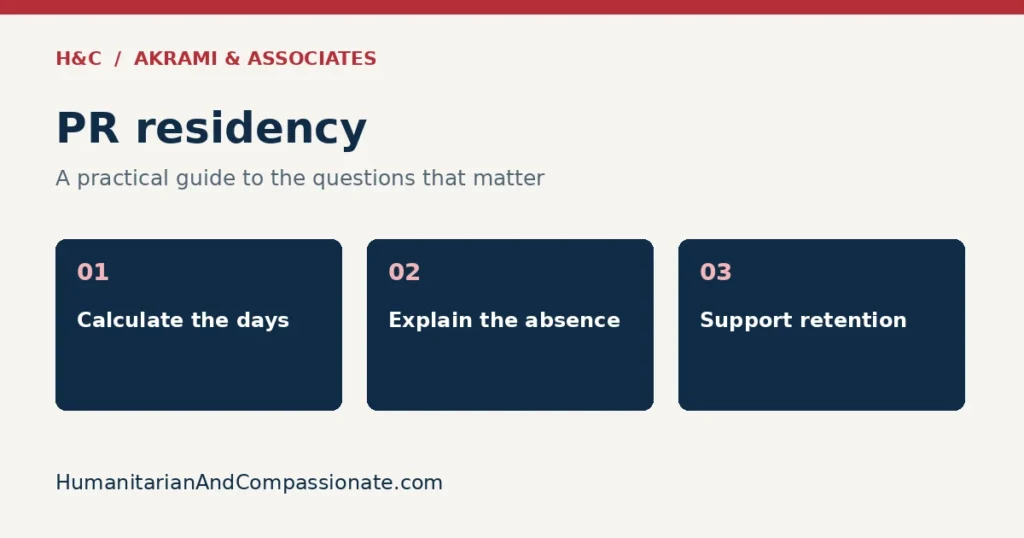
The first step is to calculate the relevant period and qualifying days accurately. Do not assume that an expired PR card means status has already been lost, or that every day outside Canada is necessarily excluded. Read the PR card and H&C residency guide for the wider framework.
Discuss a PRTD and residency-obligation concern.
Key takeaways
- A PR card is a status document; its expiry is not automatically loss of PR status.
- A PRTD concerns travel documentation for an existing permanent resident abroad.
- The 730-day requirement includes specified qualifying circumstances outside Canada.
- H&C considerations under section 28 concern retention of existing status.
- A refusal or residency determination can involve appeal rights and deadlines requiring prompt advice.
Confirm whether the PRTD process is the right one
IRCC’s Guide 5529 explains the PRTD process for permanent residents outside Canada without a valid PR card. Commercial carriers generally require a valid PR card or PRTD for travel to Canada as a permanent resident.
Establish your actual status before applying. An old card, a past landing document and a previous residency decision may need to be reviewed together. Do not assume that holding an expired card proves either current compliance or loss of status.
If you have already received a decision affecting PR status, provide it to the professional assessing your options. A PRTD application is not a general way to regain status after it has legally been lost. The correct process depends on the history.
Calculate the residency obligation before arguing H&C
Section 28 generally requires at least 730 qualifying days in the relevant five-year period. The assessment differs depending on whether the person has been a permanent resident for at least five years. For someone who has held PR for less than five years, the ability to meet the requirement within the first five years is relevant.
Start with a complete travel chronology. Record the date PR began and each entry and departure. Compare passports, travel records and other reliable documents. Mark uncertainty rather than inventing dates to make the calculation work.
Do not use the expiry date on the PR card as a substitute for determining the relevant assessment period. The card’s validity period and the statutory residency assessment are not the same thing.
Identify days abroad that may qualify
Section 28 includes specified circumstances in which days outside Canada can count. These include certain situations involving accompanying a Canadian citizen spouse, common-law partner or parent, and certain qualifying employment or accompanying relationships involving a permanent resident.
The details and definitions matter. Do not assume that any job for a business with a Canadian connection qualifies, or that every family trip counts. The relationship, employment arrangements and applicable regulatory requirements need review.
Gather evidence supporting the category relied upon. A general statement that you worked for a Canadian company may not explain the actual arrangement. Resolve the qualifying-day calculation before concluding how large the shortfall is.
Understand the role of humanitarian considerations
Section 28(2)(c) allows a determination that humanitarian and compassionate considerations justify retention of permanent resident status, taking into account the best interests of a child directly affected. A favourable determination overcomes a breach of the residency obligation before that determination.
It is not a permanent exemption from future residency requirements. Nor is it a new section 25 application to obtain PR for the first time. Using the wrong framework can lead to the wrong forms, evidence or expectations.
The request should explain the circumstances behind the absence, the relevant ties and consequences, and the evidence supporting the account. A short statement that you wish to return is not a substitute for explaining the actual history.
Explain the reasons for the absence chronologically
Describe why you left, what you expected at the time, what happened afterwards and what steps you took to return. Connect important events to documents. If circumstances changed during the absence, explain the stages rather than treating the entire period as one event.
For caregiving, identify the person, the relationship, the responsibilities and the relevant period. For health circumstances, use appropriate evidence explaining the issue and its effect. Avoid assuming that a general medical certificate explains why a lengthy absence continued.
Address difficult facts honestly. If part of the absence involved a choice, distinguish that from circumstances outside your control. A coherent account that acknowledges the full history is more useful than one that leaves significant gaps.
Show ties, establishment and the consequences of losing status
Relevant evidence may describe family relationships, a home, work history, community connections or other ties to Canada. Explain their current significance. An old record may establish a historical connection without showing what remains in place now.
Describe the practical consequences of the decision using specific facts. Avoid relying entirely on broad statements about Canada offering a better life. Explain the individual circumstances and any dependency or responsibilities involved.
If you propose to return permanently, explain the plan realistically. A plan can be relevant context, but it does not erase the earlier shortfall. Do not present a future intention as proof that the residency obligation has already been met.
Address children directly affected
Identify the child, the relationship and how the residency decision would affect them. Describe actual caregiving, schooling, health or support circumstances where relevant. Children may have different needs and should not be treated as interchangeable.
Support important statements with reliable evidence. A child’s citizenship or location alone does not explain the consequences. If alternatives are discussed, describe them realistically and explain any limitations.
Keep this analysis connected to the section 28 determination. Do not assume that a rule or exception described for a foreign national’s section 25 application applies in the same way to an existing permanent resident’s residency obligation.
Organise a focused evidence package
| Evidence group | Main question it helps answer |
|---|---|
| PR and identity records | What is the person’s status and relevant history? |
| Travel chronology | Which period and days are being assessed? |
| Qualifying days abroad | Is a statutory category supported by the facts? |
| Reasons for absence | What happened and over which dates? |
| Canadian ties and dependency | What relationships and responsibilities are involved? |
| Child-specific evidence | How is a child directly affected? |
| Return arrangements | What is the realistic proposed plan? |
Use the current PRTD application guide and checklist for required documents. This table is an organising aid for the issues, not a replacement for official instructions. Keep the administrative requirements and the humanitarian explanation both complete.
Apply through the current process
Follow IRCC’s current PRTD instructions, forms, fees and submission method. Check that the application information matches the travel chronology and supporting records. Explain discrepancies instead of hoping they will be overlooked.
Where the form asks about humanitarian considerations, provide a clear account and supporting material. Do not assume the officer will infer the request from medical records or family documents without an explanation.
Keep a complete copy of the submission and confirmation. Monitor the correct account and contact address for requests or a decision. If travel is urgent, review the current instructions and obtain advice; urgency does not guarantee a favourable residency determination or a particular processing time.
If the PRTD or residency determination is refused
Read the entire decision and any information about appeal rights. Record when you received it and seek advice promptly. Do not assume that an H&C refusal under section 25 and a residency-obligation determination have the same review route or deadline.
The Immigration Appeal Division may be relevant to a residency decision, depending on the circumstances. The professional should assess the actual decision, applicable rights and procedural requirements. Do not delay solely to gather additional evidence or submit another application.
Any question about returning to Canada while an appeal is pending requires separate review. Do not assume that filing an appeal automatically supplies the travel documentation needed to board a commercial carrier.
Book a consultation about a PRTD decision or residency shortfall.
Hypothetical example: calculate first, explain second
Imagine a permanent resident who believes they have too few days in Canada but spent part of the period abroad with a Canadian citizen spouse. The first question is whether those days qualify under the applicable rules and evidence. Only after the calculation is properly assessed can the remaining shortfall and any humanitarian request be understood.
This is an illustration of the order of analysis. It does not establish that a particular accompanying relationship qualifies or that humanitarian relief will be granted.
Frequently asked questions
Does an expired PR card mean I lost PR status?
Not automatically. Card validity and legal status are different. Review any formal decisions or other events affecting status, as well as the residency history.
Can I apply for a PRTD from inside Canada?
The PRTD process is for permanent residents outside Canada who need the document to return. Review the current IRCC instructions and the appropriate PR card process if you are in Canada.
Must all 730 days be physically in Canada?
Not necessarily. Section 28 provides specified qualifying circumstances abroad. The exact category and evidence must be assessed rather than assumed.
Is this the same as applying for H&C permanent residence?
No. Section 28 concerns retaining existing PR status despite a residency breach. A foreign national’s section 25 request concerns obtaining PR or exemptions under a different framework.
Does a family emergency guarantee approval?
No. Explain the event, dates, consequences and supporting evidence. The decision depends on the complete circumstances and applicable law.
Can I rely only on a plan to return permanently?
A realistic plan may provide context, but it does not erase the earlier shortfall. The past period, reasons for absence and other relevant factors still need assessment.
Does a favourable H&C decision waive future residency requirements?
No. Section 28(2)(c) addresses the breach before the determination. Future compliance remains important and should be planned carefully.
What should I do after a refusal?
Preserve the decision and notification date and seek prompt advice about the applicable appeal or review route. Do not assume a new application protects a deadline.
Review the complete travel and status history
A reliable calculation and clear explanation are the starting points. Book an H&C residency consultation or call 416-477-2545, and bring your PR records, travel chronology and any decision already received.
Official sources
General information only. Individual circumstances require professional assessment. Sources checked November 26, 2026.