On this page
A refused refugee claim does not automatically make an H&C application available. The answer depends on the current wording of section 25, the claim’s procedural history, related proceedings and any applicable exceptions or transitional provisions. Do not assume that waiting 12 months, having a child or withdrawing a claim resolves every restriction.
This guide helps you organise the decisions and dates needed for a professional assessment. It does not advise you to withdraw a refugee claim or choose between protection and humanitarian processes. Those decisions can have serious consequences and require individual advice.
Discuss your refugee history and H&C questions.
Key takeaways
- H&C and refugee protection answer different legal questions.
- The current statute contains more than one refugee-related restriction.
- An exception to the 12-month rule is not an exception to every other rule.
- The relevant date may involve appeal or Federal Court proceedings.
- Filing an H&C request does not automatically prevent removal.
Why older summaries may not give the full answer
Online explanations often focus on the 12-month period after a negative refugee decision. That is an important part of section 25, but it is not the only part. The current text also addresses claims determined eligible for referral to the Refugee Protection Division, as well as claims pending before that Division or the Refugee Appeal Division.
Section 25(1.2)(b.1) separately addresses a claim determined ineligible for referral where an application for protection to the Minister is pending. These provisions make the exact procedural history important. A phrase such as “my refugee case is closed” is not enough to identify the applicable restriction.
The version of the legislation and any transitional rules relevant to the person must be checked. This is an area where a professional reviewer should reconcile current statutory wording with older program summaries before advising on whether an application can be examined.
H&C is not a second refugee hearing
A refugee claim concerns protection under its own legal framework. An H&C request asks for legally available humanitarian relief in connection with permanent residence. The application should not simply repeat a refugee narrative and assume the same evidence will be assessed in the same way.
Section 25 distinguishes the humanitarian assessment from specified refugee protection factors while requiring consideration of relevant hardship. How evidence is used matters. A professional can help explain the distinction without dismissing the person’s experiences or treating every country-related concern as irrelevant.
Review the H&C eligibility guide for the broader requirements. Eligibility to have a request examined and the strength of the humanitarian circumstances are separate issues.
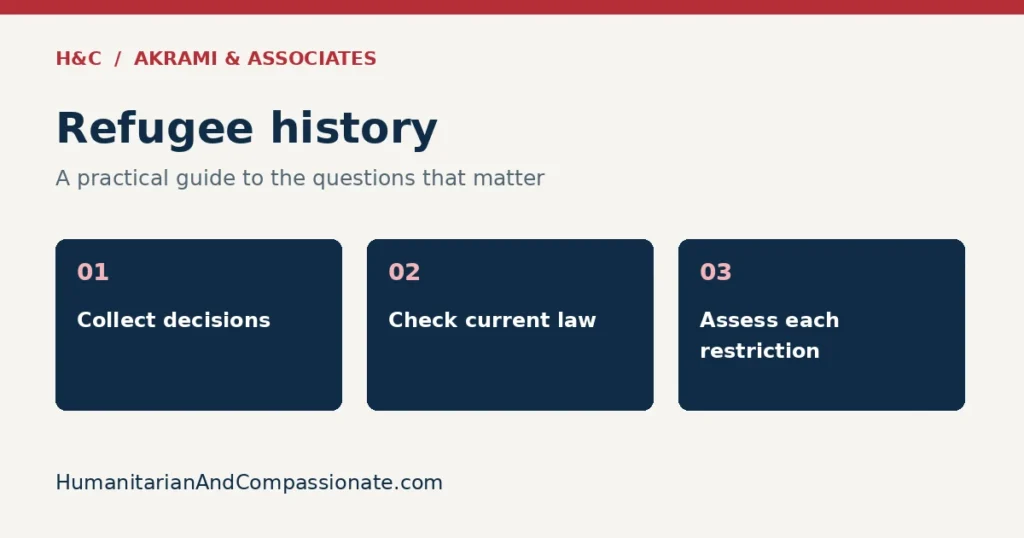
Collect the actual decisions before calculating dates
Prepare a chronology supported by the documents. Include the refugee referral decision, hearing outcome, Refugee Appeal Division steps, Federal Court leave or judicial review proceedings, and any protection application. Record dates of decisions and dates received where available.
A rejection, withdrawal and abandonment are not interchangeable descriptions. The legislation also refers to withdrawal after substantive evidence was heard in the context of the 12-month restriction. The wording of the decision and the stage of the proceedings may therefore matter.
If a document is missing, tell the adviser rather than guessing its contents. A previous representative may hold records that are needed to understand the history. Do not delay raising an urgent deadline while trying to assemble a perfect file.
Understand the limited role of the 12-month rule
Section 25(1.2)(c) restricts examination within 12 months of specified refugee outcomes. Where appeal or Federal Court proceedings occurred, the relevant calculation can involve the latest of the statutory events. It should not automatically be calculated from the first refusal letter.
Even if that period has passed, another restriction may still require analysis. Treating the anniversary as an automatic eligibility date can overlook the rest of the statute. Ask the professional to identify each relevant provision and explain which one is being addressed.
Avoid using an online calculator or another person’s timeline as the legal answer. Two applicants with apparently similar histories can have different procedural steps. A document-based chronology is more reliable than a remembered sequence of dates.
Exceptions relating to children and health
The legislation provides limited exceptions to the 12-month restriction. One concerns an adverse effect of removal on the best interests of a child directly affected. Another concerns a risk to life caused by the inability of the relevant country or countries to provide adequate health or medical care.
The exception must be supported by evidence and applied to the correct provision. It does not itself approve the humanitarian request. Nor should it be presented as an exception to every refugee-related restriction in section 25.
For a child-related argument, explain the actual circumstances and direct effect. For a health-related argument, obtain appropriate evidence about the condition, needs and relevant care situation. General statements that Canada offers better schools or health services do not by themselves explain the statutory exception.
Do not withdraw a claim based on a general article
Withdrawal can affect protection proceedings and enforcement. It should not be treated as an administrative shortcut to H&C. Older summaries may describe withdrawal in terms that do not fully address the current statutory text or the person’s circumstances.
Before any decision, obtain advice about the available processes, the consequences of withdrawal and the current restrictions. The existence of an H&C option in someone else’s case does not show that it is available or advisable in yours.
A professional assessment should explain the choices in language you understand. Ask what happens to each pending proceeding and whether any deadline continues to run. Keep a written record of the steps you decide to take and why.
Other restrictions still need review
A pending H&C request, designated foreign national rules and excluded inadmissibility grounds may also matter. The refugee history is only one part of the screening. Provide complete information about previous applications and decisions.
Being designated is a specific legal matter. Do not assume that every irregular arrival has the same status or dates. If you received a designation notice, include it in the review package along with the related protection decisions.
Our restrictions guide explains why access to humanitarian consideration must be checked before preparing a lengthy submission. The inadmissibility guide addresses another separate part of that assessment.
Keep removal questions separate
A person may face enforcement while considering humanitarian options. An H&C submission does not automatically delay or prevent removal. Provide CBSA notices, reporting instructions and any scheduled removal date to the professional promptly.
Do not assume that an exception allowing examination also creates permission to remain or work. Those consequences require their own legal basis. Similarly, a pending court or protection matter must be assessed according to its actual status and applicable rules.
If there is an immediate deadline, call the office and state it clearly. A general contact form is not a substitute for confirming that a professional has agreed to act on an urgent matter.
A practical consultation checklist
| Document or fact | Question it helps answer |
|---|---|
| Refugee referral determination | What happened at the eligibility stage? |
| RPD decision and hearing history | What outcome occurred and at what stage? |
| RAD documents | Was an appeal made and decided? |
| Federal Court documents | Was leave sought or judicial review decided? |
| Protection application records | Is a related application pending? |
| Child or health evidence | Is a specific statutory exception being raised? |
| CBSA correspondence | Is there a separate enforcement deadline? |
Add a short list of missing records and uncertainties. This helps the consultation focus on what can be assessed now and what information is still needed.
Book a consultation to review the decisions and dates.
Hypothetical example: the same refusal date, different histories
Imagine two people whose refugee claims were refused on the same day. One pursued an appeal and later court proceedings; the other did not. Their relevant timelines may differ, and both still need a review of the other statutory restrictions.
This example illustrates why the first refusal date is not a complete eligibility test. It does not state that either person can apply or that a particular exception is available.
Frequently asked questions
Can every failed refugee claimant apply after one year?
Do not assume so. The 12-month restriction is only part of the current statute. Other restrictions, procedural history and any applicable transitional rules require review.
Does having a Canadian child remove the restrictions?
No. Children’s interests can be relevant to a specific exception and to the merits, but they do not automatically remove every restriction or guarantee approval.
Can I withdraw my claim to apply for H&C?
Do not take that step based on a general summary. Obtain advice about current law and the consequences for protection and removal before deciding.
Does a pending protection application matter?
It can. Section 25 contains a provision concerning certain ineligible refugee claims followed by a pending protection application. Provide the exact documents and status for assessment.
Is H&C the same as a refugee appeal?
No. The processes have different purposes and legal frameworks. An H&C request should not be assumed to reopen or overturn the refugee decision.
Which date starts the 12-month calculation?
That depends on the statutory events and the proceedings in the case. Appeal and Federal Court steps may matter. Have the chronology checked against the current legislation.
Will an H&C filing stop removal?
Not automatically. Enforcement requires separate attention. Give the adviser all CBSA documents and identify any scheduled date immediately.
What should I do if an online guide conflicts with the law?
Use the legislation as the legal starting point and seek an explanation of how it applies. Program summaries may simplify rules or lag behind amendments.
Get the legal starting point clear
Before preparing the full application, establish whether and how the request can be examined. Book an H&C consultation or call 416-477-2545, and bring the complete refugee and immigration chronology.
Official sources
General information only. Individual circumstances require professional assessment. Sources checked November 26, 2026.